Soil moisture
The probe works from the dielectric constant of the soil reaction and derives real moisture content from it — the product page states this method is in line with international standards at present.
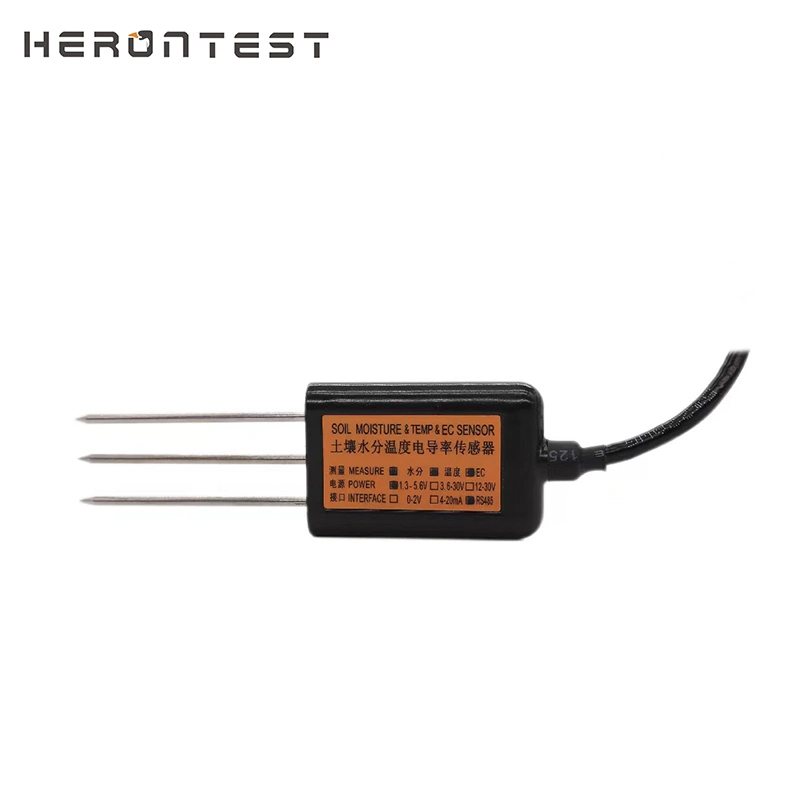
Choosing a probe starts with the medium it will live in. This guide reads the HNT-MEC10 3 in 1 soil moisture sensor against the three ways sites actually run — long-term burial in a soil profile, continuous submersion, and fertilizer or nutrient solution matrices — and shows how a precision agriculture soil sensor slots into loggers, data acquisition and automation. Every point below traces back to the published product details: dielectric-constant moisture sensing, EC and temperature in one body, alloy electrodes, and a fully sealed housing.

What the product page states, and what each line means when you are preparing an inquiry.
| Model / part number | HNT-MEC10 |
|---|---|
| Parameters measured | Soil moisture content, electrical conductivity (EC) and temperature — three readings from one device |
| Moisture principle | Dielectric constant of the soil reaction; the page notes this method is in line with international standards at present |
| Electrode material | Specially treated alloy, resistant to acid and alkali corrosion and to mechanical impact |
| Housing | Completely sealed — suitable for burial in soil or direct immersion in water |
| Output | Multiple protected signal output interfaces; specific interface types confirmed at quote |
| Deployment modes | Buried in soil or submerged in water for long-term dynamic testing; also used for fertilizer and other nutrient solution conductivity matrices |
| Customization | OEM and ODM customization offered through inquiry |
Three readings, three different control questions. Knowing which one drives your project keeps the inquiry short.
The probe works from the dielectric constant of the soil reaction and derives real moisture content from it — the product page states this method is in line with international standards at present.
EC describes how conductive the solution around the probe is. The product page positions the probe for fertilizer and other nutrient solution conductivity matrices, so the reading belongs to that liquid, not just to soil.
Temperature is measured inside the same body as moisture and EC, so each reading set carries the thermal context of the same point in the profile instead of a nearby air sensor.
The medium decides the mounting, the service routine and the questions worth asking before you order.
The sealed housing is designed for long-term burial, and the probe insert design keeps stable contact with the surrounding soil so readings reflect the profile rather than the air gap around the body.
The product page states the probe can be directly immersed in water for long-term dynamic testing. Reservoir, tank and channel monitoring is therefore a supported mode rather than a workaround.
The same probe is listed for fertilizer and other nutrient solution conductivity matrices, so EC can sit alongside moisture and temperature in one record instead of a separate handheld check.
Start from the site, not the datasheet. Each scenario below points to the configuration question that actually changes the quote.
A probe that stays in the ground for the season needs a body that survives burial and electrodes that tolerate the local soil chemistry.
Where irrigation and nutrient dosing run together, one probe covering moisture, EC and temperature removes a second instrument from the bench.
Salt load and fertilizer residue are what shorten probe life. The specially treated alloy electrodes are the part of the specification to argue over here.
If the probe becomes part of your own system, the conversation moves from a single unit to a repeatable configuration.
Sealed housing Alloy electrodesThe probe only earns its place once the signal reaches the system that acts on it.
A perfect protection circuit and a range of signal output interfaces intended for data acquisition systems, loggers and agricultural automation. The page does not name protocols, voltage or connector types, so those details are settled per project.
Name the endpoint first — a logger, a data acquisition unit or an automation controller — then describe the run between probe and cabinet. Interface options are confirmed at quote, and OEM or ODM customization is available when a standard build does not fit.
Send your interface requirement →Send the medium, the deployment mode, the cable run and the system you are wiring into. We will come back with a configuration for the HNT-MEC10 — including the signal output interfaces that suit your setup, and OEM or ODM options where the standard build is not the right fit.
review the product details, images, and specifications presented on the official product page.
use the application and use-case information published on the official product page.
confirm the specifications and options listed for the exact product variant before placing an order.
check the official product page or ask the supplier about options shown for the selected product.
use the official contact or inquiry path provided on the site.
include the product page, intended use, required quantity, and any specifications you need the supplier to review.