Specification:
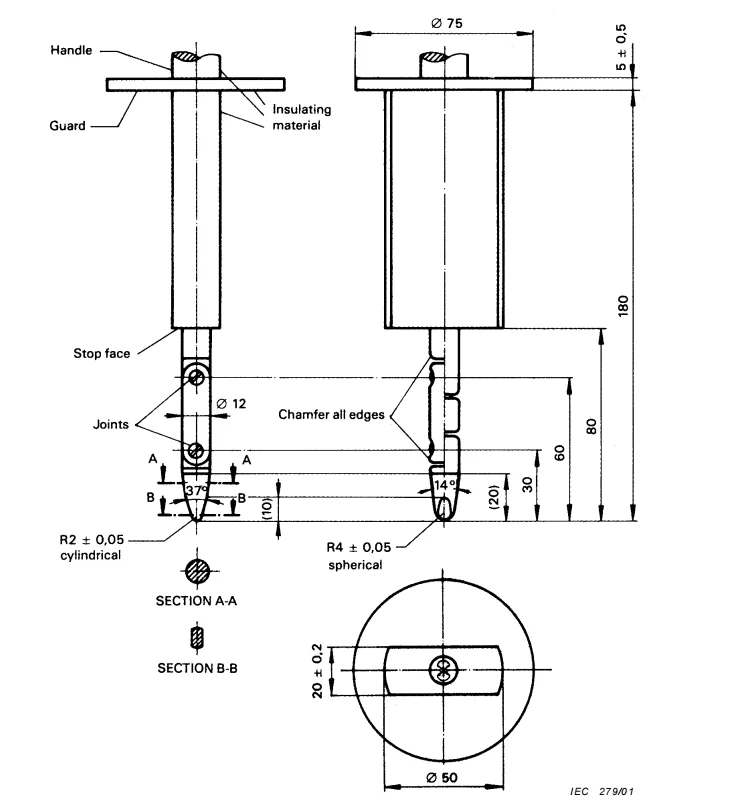
1. Diameter of curved finger: 12 mm
2. Bending finger length: 80mm (total length of three sections)
3. Diameter of baffle: 50mm
4. Baffle length: 100mm
5. Reference standard: IEC60065, IEC 60335-1, IEC 60529, IEC60884-1, IEC60950, IEC61032, IEC69745-1

The IEC 61032 Test Finger Probe B is the articulated finger that standards name when an enclosure has to be shown to be finger-safe. Its contact section is a 12 mm curved finger, and the finger itself is built in three jointed sections so it can bend and follow the shape of an opening instead of only proving that a straight line is blocked.
What the probe proves is straightforward: nothing a finger can reach should be live, and where the clause also covers mechanical parts, nothing hazardous should be reachable either. Its specimen range is the easily accessible live parts or mechanical parts of the enclosure — the apertures, louvres and moulded gaps a user can touch without a tool.
The jointed construction is what separates it from a rigid gauge. A rigid rod answers one question — does a straight tool get through — while the three sections let you re-position the finger before, during and after insertion, following the route a real finger would take. Behind the articulated sections sits a white plastic grip with a round guard flange, and the contact end carries a metal tip that makes the stopping point easy to read against a dark enclosure face.
This is the articulated finger of IEC61032 Figure 2 and of the IEC60529 / EN60529 family, which is why it is the tool most commonly cited for the finger-access requirement in the IP code. Laboratories working to appliance, IT, audio-visual, plug-and-socket or UL clauses often find the same finger already on the bench, and one tool cited across all of those programmes is easier to store, check and document than three or four near-neighbours.
If you already have the clause, the specification table below gives you the dimensions to check against it. If you are still working out which probe your clause names, send us the standard and figure you are testing to and we will confirm the designation before you order.
| Model no. | HNT-PB |
| Probe type | Articulated test finger, probe B |
| Curved finger diameter | 12 mm |
| Bending finger length | 80 mm across three jointed sections |
| Jointed sections | Three, independently articulated |
| Baffle diameter | 50 mm |
| Baffle length | 100 mm |
| Standard figure reproduced | IEC61032 Figure 2 |
| Protection level | IP2X — protection against access with a finger |
| Related clauses cited | IEC60065, IEC60335-1, IEC60529, IEC60884-1, IEC60950, UL507, EN60529 figure 1, UL1278 figure 8.4 |
The reference list for this probe runs wider than the figure itself. At its centre is IEC61032 Figure 2, the drawing that defines the articulated test finger and the reason the tool is quoted as Test Tool B; the same geometry is cited in the IEC60529 / EN60529 family, where the articulated finger is the probe used to demonstrate protection against access with a finger.
Appliance laboratories reach it through IEC 60335-1, the general safety standard for household and similar electrical appliances. Audio, video and similar electronic apparatus work brings in IEC60065, information technology equipment brings in IEC60950 and the earlier IEC950 Figure 2A, IEC60884-1 covers plugs and socket-outlets, and IEC69745-1 also appears on the list. North American programmes are covered as well: UL507 and UL1278 Figure 8.4 sit alongside the IEC references, so the same finger is ordered by laboratories working to UL clauses rather than, or as well as, IEC ones.
Why that breadth matters in practice. One finger can serve appliance, IT, audio-visual and socket work from the same tool store — one part number to keep and check instead of four, one reference list to put in front of an assessor who questions the tool itself, and fewer surprises when a product line changes and the clause cited for it changes with it.
The one thing worth doing before you order is matching the figure. If your clause cites Figure 2, Test Tool B or probe B, this is the item. If your test plan names a different figure, a different letter, or an applied force as well, tell us and we will point you to the version that matches rather than let a near-match reach your bench. In IP2X electrical enclosure safety testing, the probe is the measuring instrument, and the figure reference is what identifies it.
| Probe | Access check it covers |
| Articulated test finger B | IP2X — finger access (this probe) |
| Force-controlled finger B | IP2X, where the clause applies a specified thrust |
| Rigid test rod C, 2.5 mm | IP3X — access with tools and wires |
| Rigid test wire D, 1.0 mm | IP4X — access with a thin rigid wire |
| Test pin probes | Pointed-tool access to live parts in Class 0 and Class II equipment |
| Articulated accessibility probe | Enclosure access checks to UL requirements for moving parts |
Choosing the right item starts with your requirement, not the catalogue. Our technical team works with buyers in Europe, North America and Asia to match a model to the clause or test condition you have to satisfy, and stays with you afterwards for commissioning, setup and troubleshooting. If an instrument already in service needs attention, we can supply replacement parts and advise on returning it to work. OEM and ODM requests go to the same team.
It checks whether anything within a finger's reach is live, and whether anything hazardous can be reached where the clause also covers mechanical parts. The contact section is the finger-sized part of the tool, and the three jointed sections give it the reach and flexibility of a real finger, so a pass means a hand cannot get past the opening either. The specimen range is the easily accessible live parts or mechanical parts of the enclosure — the openings a user can touch without a tool.
Yes. This IEC 61032 Test Finger Probe B is the articulated finger the standards describe as Test Tool B; it is the tool drawn as Figure 2 of IEC61032 and cited in the IEC60529 / EN60529 family for the finger-access requirement. Because the same geometry is referenced by the appliance, IT, audio-visual, plug-and-socket and UL lists, one finger usually covers several programmes in the same laboratory. If your test plan names a different figure number or letter, check that reference with us before ordering.
A rigid gauge only tells you whether a straight line reaches. The three jointed sections can be angled and re-positioned before, during and after insertion, so IP2X electrical enclosure safety testing follows the route a finger could actually take through a louvre, a grille slot or a gap between mouldings. The sections are set by hand, and the baffle disc stays against the enclosure face so insertion depth remains controlled while you sweep the opening.
The reference list includes UL507 and UL1278 Figure 8.4 alongside the IEC standards, so laboratories working to North American programmes can use the same finger. Where a UL clause applies a specified force or names a different probe, send us the clause and we will confirm which version your test actually calls for.
The disc is the stop. It sits against the enclosure face and limits how far the finger can travel into the opening, which is what makes insertion depth repeatable between operators and between test sessions. The body behind the disc gives you enough to hold on a large panel without your hand covering the feature you are checking.
Match three things: the standard and figure your clause names, the probe designation (Test Tool B, or probe B), and the dimensions your report has to be checked against. As an IP test finger supplier we compare the figure and dimensions you send with the clause before quoting, and we will say so if your clause actually supports a rigid rod, a rigid wire or a force-controlled finger instead. That check is worth doing before the order rather than after the sample fails.