UL507 IEC62368-1 Annex V.1 Test Finger Articulated Accessibility Probe PA100A
UL507. The probes referenced in Table 9.1 and illustrated in Figure 9.2 shall be applied to any depth that the opening permits and shall be rotated or angled before, during, and after insertion through the opening to any position that is necessary to try to contact an uninsulated live part or film-coated wire. If necessary, the configuration shall be changed after insertion through the opening. Configuration refers to positioning of the jointed portions of the probes UL60950-1. The articulated accessibility probe of Figure EE.3 shall be inserted into each opening in the MECHANICAL ENCLOSURE, without appreciable force.
The test finger shall not contact hazardous moving parts. This consideration applies to all sides of the MECHANICAL ENCLOSURE when the HOUSEHOLD AND HOME/OFFICE DOCUMENT/MEDIA SHREDDERS is mounted as intended in accordance with the manufacturer’s instructions for use. In some cases, operation of the equipment may be necessary to determine accessibility (for example, where a guard or cover is only opened after the unit is energized and ready for use) when applying both the test finger and wedge probe.


The articulated accessibility probe is a jointed test finger for the UL507 check on mechanical enclosures that contain moving parts. A rigid rod travels in one line; this probe is made in three articulated sections that can be rotated and angled as they pass through an opening, and then re-set to a different configuration once they are inside. That is the movement a UL507 or IEC62368-1 Annex V.1 clause depends on when the question is whether a finger can reach a hazardous moving part inside a mechanical enclosure — a question a straight probe cannot answer.
It is a bench tool for people who run these checks week after week: compliance and certification engineers reproducing a clause for a report, lab technicians working through the openings of an enclosure, in-house QC and incoming-inspection staff checking production units, and R&D engineers validating a design before it goes for type testing.
The probe also sits inside a wider set of accessibility tools rather than replacing them. Labs that already hold other accessibility probes will recognise the format at once; the jointed finger is the piece they add when a UL or IEC62368-1 clause brings moving parts into scope, and it is supplied as a single item ready for the bench.
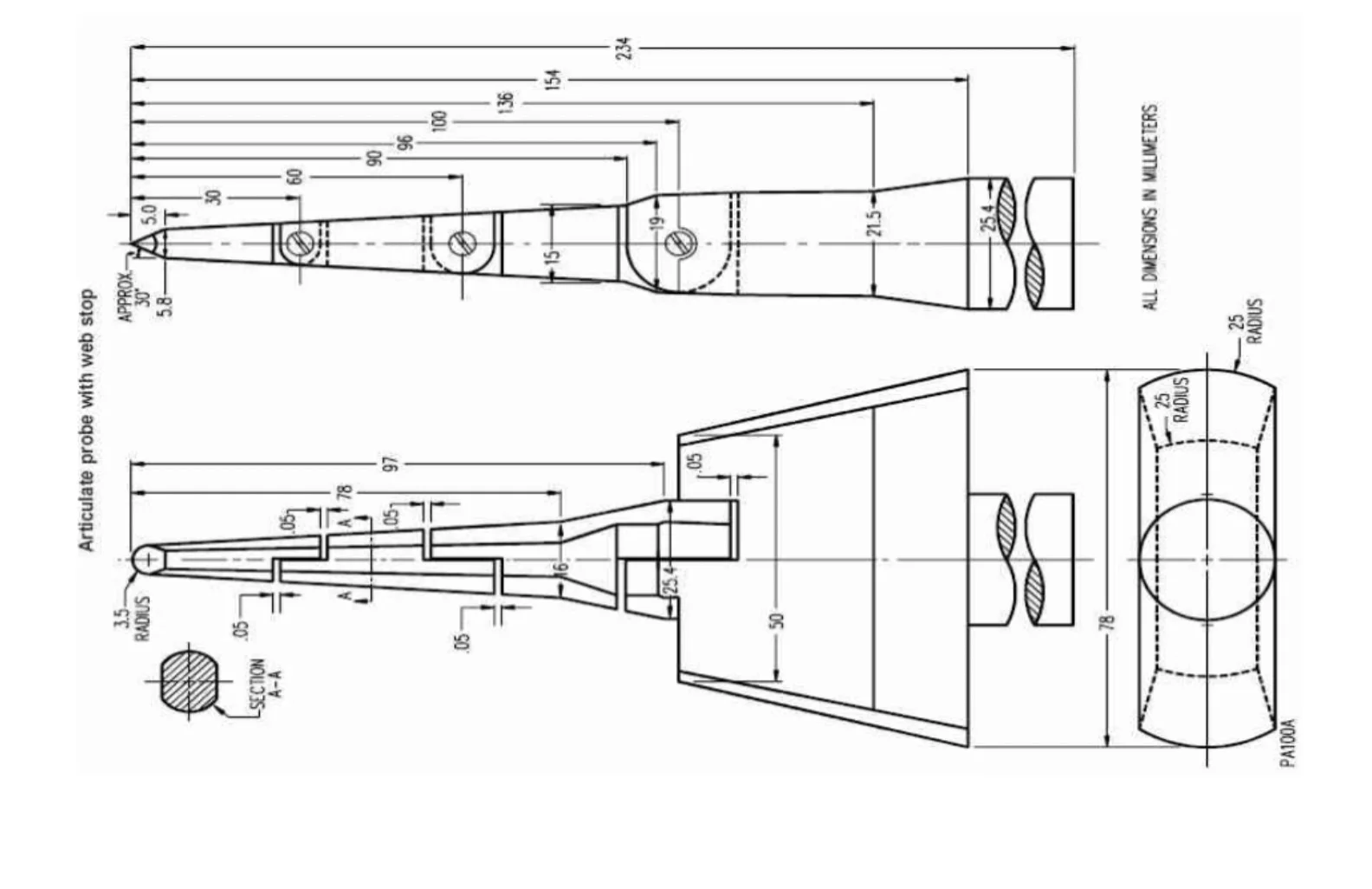
| Probe type | Articulated accessibility test probe with a jointed finger |
| Curved finger diameter | 12 mm |
| Bending finger length | 80 mm (total of the three jointed sections) |
| Finger configuration | Three articulated sections with a hinged tip |
| Baffle diameter | 50 mm |
| Baffle length | 100 mm |
| Applied force | Inserted without appreciable force, as the clause states |
| Equipment covered | Mechanical enclosures of fans, shredders and similar equipment with hazardous moving parts |
| Item reference | HNT-507 |
The UL507 PA100A Articulated Probe is defined by the figures it is made to, so the standard reference is worth checking against your test plan before you order. In UL507 it is the probe listed in Table 9.1 and illustrated in Figure 9.2, applied to any depth the opening permits. In IEC62368-1 it is the articulated accessibility probe of Annex V.1. In UL60950-1 the same jointed geometry is the Figure EE.3 articulated accessibility probe for mechanical enclosures.
The probe is also published with reference to IEC60065, IEC60335-1, IEC60529, IEC60884-1, IEC60950, IEC61032 and IEC69745-1. Read that list as the umbrella of standards the tool sits under — when one of them names an articulated accessibility probe, this is the type of finger the clause expects, and a lab that works across several programmes keeps one item on the bench rather than one per project.
If your test plan quotes a figure we have not listed here, send it through anyway; we will confirm whether this probe covers it before the order goes ahead.
| Probe | Reference standard and figure | What it verifies | Applied force |
| PA100A articulated accessibility probe (this item) | UL507 Table 9.1 and Figure 9.2; IEC62368-1 Annex V.1; UL60950-1 Figure EE.3 | Whether a jointed finger can reach a hazardous moving part or an uninsulated live part through an opening in a mechanical enclosure, as in a fan enclosure moving parts safety test | Inserted to any depth the opening permits, without appreciable force |
| Jointed test finger B, plain version | IEC61032 Figure 2; IEC60529 and the appliance standards that list it | Finger-touch access at the IP2X level — whether an opening admits a finger-sized route to a live or hazardous part | Applied by hand; order the thrust version when the test names a force |
| Jointed test finger B, 50 N thrust version | IEC61032 Figure 2, supplied as the thrust version | The same IP2X access question, where the clause requires the finger to be pressed at a defined force | 50 N |
| Rigid test rod C | IEC61032 Figure 3; IEC60529; 2.5 mm probe | First characteristic numeral 3 and the additional letter C — a tool or metal wire of that size | 3 ± 0.3 N where the test requires thrust |
| Rigid test wire D | IEC61032 Figure 4; IEC60529; 1.0 mm probe | First characteristic numeral 4 — a thin wire of that size | 1 N version available |
Choosing the right item starts with your requirement, not the catalogue. Our technical team works with buyers in Europe, North America and Asia to match a model to the clause or test condition you have to satisfy, and stays with you afterwards for commissioning, setup and troubleshooting. If an instrument already in service needs attention, we can supply replacement parts and advise on returning it to work. OEM and ODM requests go to the same team.
Both are jointed fingers, but they are bought against different clauses. The Figure 2 finger belongs to the IP2X accessibility family and is also supplied in thrust versions for tests that state an applied force. The UL507 PA100A Articulated Probe is the articulated accessibility probe for UL507 Table 9.1 and Figure 9.2, IEC62368-1 Annex V.1 and UL60950-1 Figure EE.3, and its purpose is access to hazardous moving parts inside a mechanical enclosure. If your test plan cites an IEC 61032 figure rather than one of those clauses, tell us which figure and we will confirm the right probe for it.
No. IP testing works with the IP probe family — the jointed finger B for the IP2X check, rod C for IP3X and wire D for IP4X — and each of those is bought against the first characteristic numeral it verifies. This articulated probe answers a different question: whether an opening lets a finger reach a hazardous moving part. The two checks are often run on the same enclosure, but the tools are not interchangeable.
That depends on the clause. Some of the tests that call for the articulated accessibility probe apply the test finger and the wedge probe together, so a lab working to those clauses keeps both on the bench. Check the clause your report is being written against, and tell us if you need both — they can be quoted on the same enquiry.
Every probe is measured against the figures it is supplied to before it is packed, and the joints are checked to make sure they move freely. The dimensions to compare against your standard are the curved finger diameter, the bending length across the three jointed sections, and the baffle diameter and length; they are listed in the specification table above. Keep the probe in its case between tests and never use the finger as a lever — a bent finger or a stiff joint is what invalidates a repeat run.
Mechanical enclosures where hazardous moving parts sit behind an opening: fans and fan enclosures, household and home/office document and media shredders, and similar equipment. A fan enclosure moving parts safety test is the clearest example, because the finger has to pass through the grille or opening and then be angled inside — which is exactly what the jointed sections are for.
Yes. The same articulated geometry is called for by the UL507 probe of Table 9.1 and Figure 9.2 and by the IEC62368-1 Annex V.1 articulated accessibility probe, so one probe covers both checks — labs that report against a North American scheme and an IEC scheme keep a single item on the bench. As a UL standard test probe supplier we record the clause you are demonstrating on the quotation, so the probe can be filed against the standard in your report.